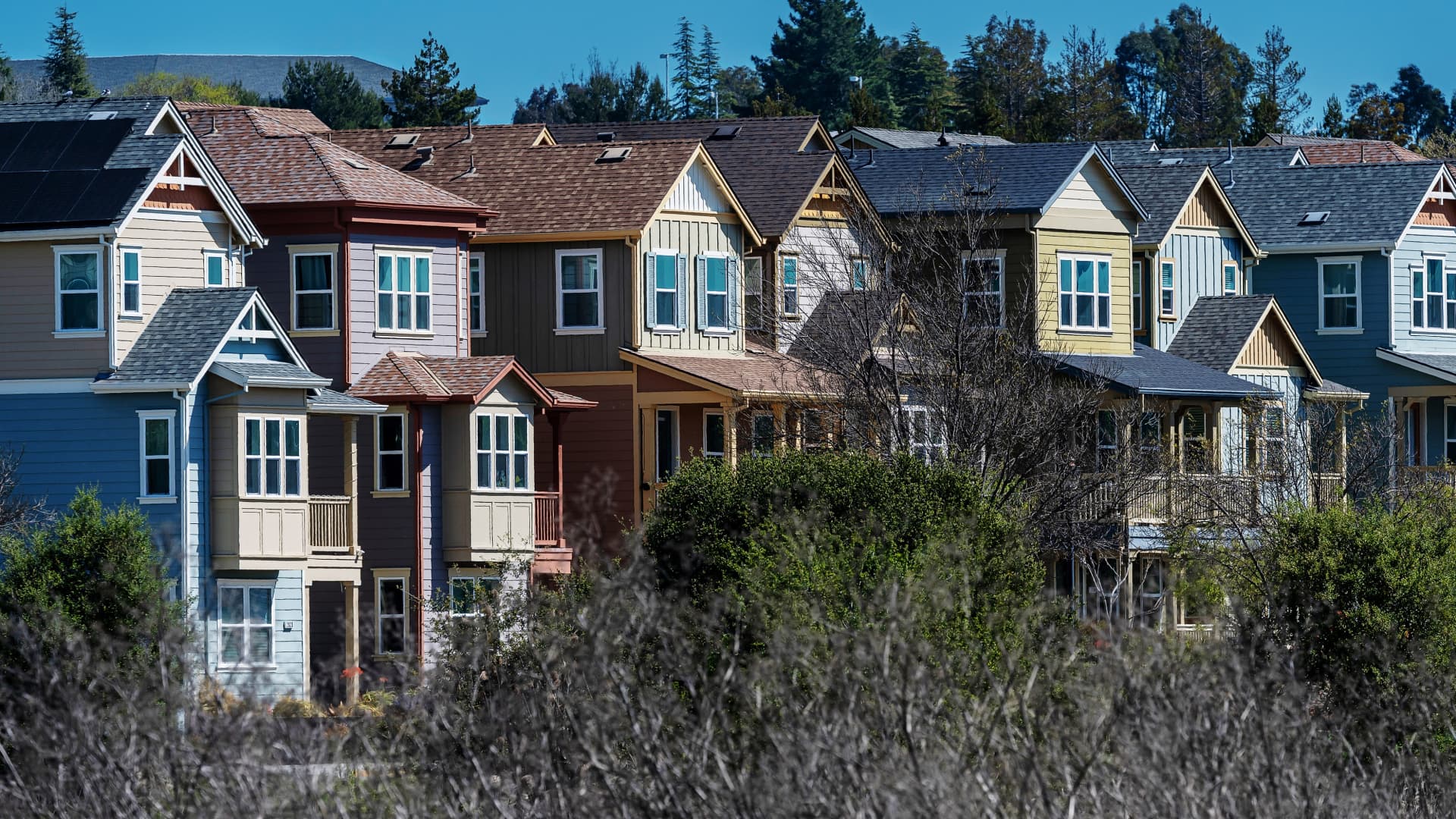
A ‘For Sale’ sign is posted beside property for sale in Alhambra, California.
Frederic J. Brown | AFP | Getty Images
Mortgage rates fell sharply on Friday, a day after President Donald Trump said on social media that he is instructing mortgage giants Fannie Mae and Freddie Mac to buy $200 billion in mortgage bonds.
“This will drive Mortgage Rates DOWN, monthly payments DOWN, and make the cost of owning a home more affordable,” he said in the Truth Social post.
The rate on a 30-year mortgage dropped 22 basis points to 5.99%, matching the low from Feb. 2, 2023, according to Mortgage News Daily.
Fannie Mae and Freddie, which are in government conservatorship, do not originate home loans. They buy loans from lenders, bundle them into mortgage-backed securities, or MBS, and sell them to investors — thereby replenishing lender funds for new loans and keeping interest rates lower and more stable for homebuyers.
Purchasing more mortgage-backed bonds or securities does move mortgage rates lower. In the first two months of the Covid pandemic, as markets reeled, the Federal Reserve purchased $580 billion in agency MBS. It then continued buying more throughout the year. From March 2020 through June 2021, the Federal Reserve increased its agency MBS holdings from $1.4 trillion to $2.3 trillion, according to the Dallas Fed.
The Federal Reserve also lowered its own lending rate to zero. The combination brought the average rate on the 30-year fixed mortgage to record lows, hitting just 2.75% at the start of 2021, according to Mortgage News Daily.
“How big a deal is $200 billion? This depends on a few factors, but the reaction in the MBS market is enough to tell you that it matters,” said Matthew Graham, chief operating officer at Mortgage News Daily which tracks rates closely and is already seeing them fall just from the news of the announcement.
While it is still not known how quickly this would start and how long it will take, analysts are predicting where mortgage rates could end up; most put the drop somewhere between 25 and 50 basis points, some even lower.
“We believe that $200bn of MBS purchases could drive a ~10-25bps reduction in mortgage rates, potentially reducing the current 30-year headline mortgage rate to roughly 6.0% (current 6.21%). While still elevated relative to the average outstanding mortgage rate of 4.4% and the 3.25% levels as recently as Jan 2022, this decline may provide a boost to both new construction demand and existing home turnover,” analysts at UBS wrote.
Put simply, if rates were to drop even to 5.9%, for someone buying the median-priced home — which is right around $425,000, according to the National Association of Realtors — using a 30-year fixed mortgage with a 20% down payment, the monthly payment would drop by $118. For some, that may not seem like a lot, but for first-time buyers on the edge of affordability, it could make a difference. They would still, however, need to save for the down payment, which is currently the biggest hurdle for most first-timers.
Homebuilder stocks rallied on the news, but they were already buying down mortgage rates prior to this well into the 5% range. Their concerns lately have been more focused on increasing costs from tariffs and a continued labor shortage. That said, just the news of this could have an impact on buyer demand for the builders.
“I think psychologically it will help,” said Ivy Zelman, executive vice president of research and securities at Zelman, a Walker & Dunlop company. “I think that today, people that have been looking that didn’t even know builders were offering mortgage rate buydowns might step into the market.”
But Zelman also points out that in the broader home market it’s not just the mortgage rate, but overall affordability that is keeping buyers sidelined. Consumers are stretched, and home prices are close to 50% higher than they were pre-pandemic, ironically because of those record-low mortgage rates brought on by MBS purchases.
“This is not enough to really get the market going because we know people can’t qualify even at 4.99%. They can say that the mortgage rates are going to go down to below 5, but we have people that still can’t qualify at 4.99%, so I think there’s more work to be done,” Zelman said.
This could also help builder margins, which have been shrinking lately because of higher costs.
“From a demand perspective, [it is] maybe a marginal benefit from the positive psychological impact on consumers,” said John Lovallo, analyst at UBS. “Bigger is the potential ability for builders to begin pulling back on incentives to some extent which would be very accretive to gross margins.”
The drop, however, could also help current homeowners to save on their monthly payments through a refinance. Rates have already been dropping steadily, with the 30-year fixed down from it’s recent peak of 7.16% one year ago. Applications to refinance a home loan were already 133% higher year over year before this announcement, according to the Mortgage Bankers Association.
The general rule of thumb is that a refinance is only worth the cost if you can save more than 75 basis points on a mortgage rate. This would add many more potential candidates to the refinance pool, especially those who took out their loans over the last two years. The vast majority of homeowners, however, still have rates below 4%.