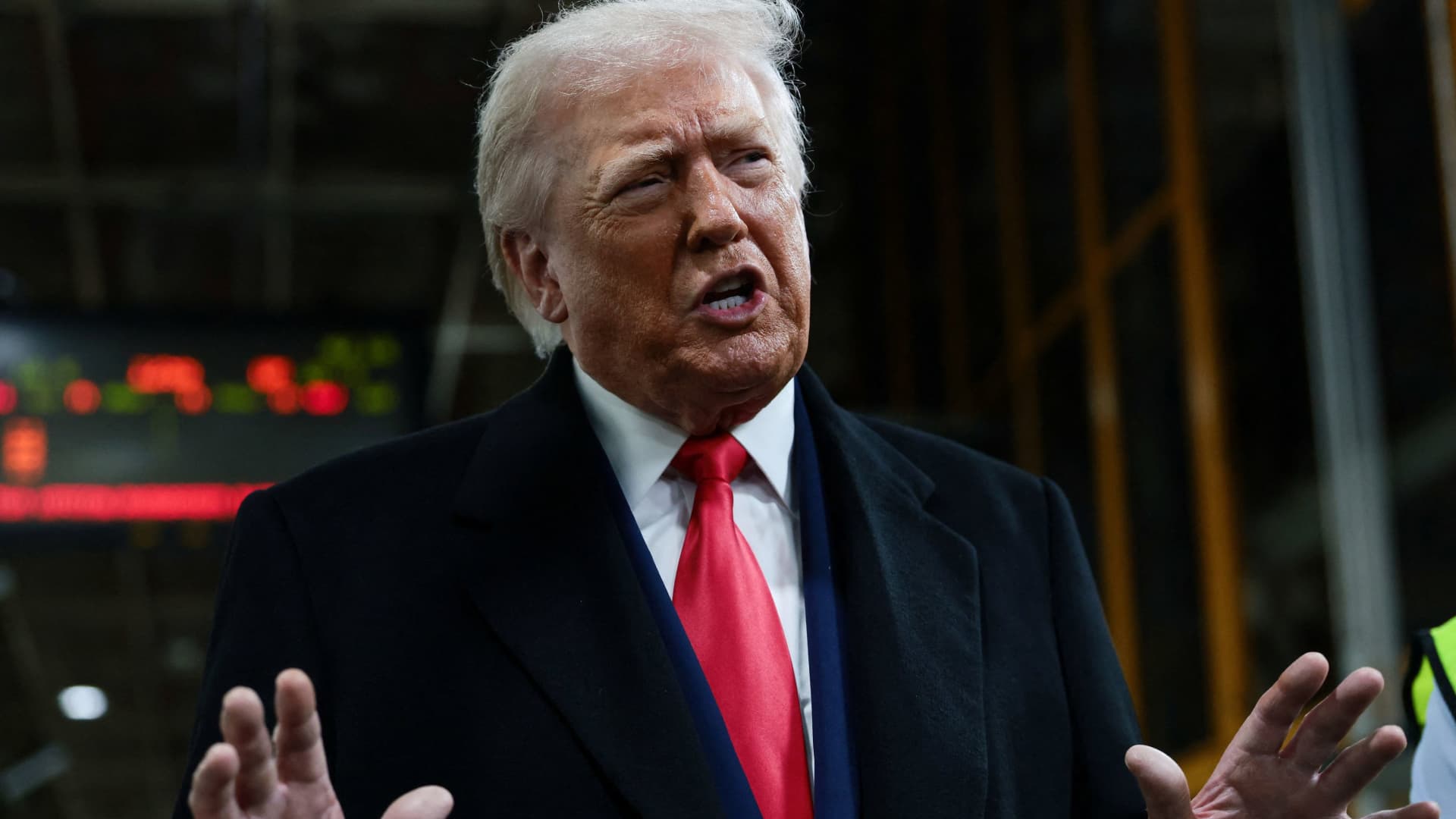
U.S. President Donald Trump visits a Ford production center in Dearborn, Michigan, U.S., January 13, 2026.
Evelyn Hockstein | Reuters
U.S. President Donald Trump said in a Truth Social post on Tuesday that he had “cancelled all meetings with Iranian Officials,” and reiterated his support for protestors fueling one of the largest anti-government demonstrations in the Middle Eastern country.
Trump’s move suggests that diplomatic methods aimed at compelling Tehran to cease its violent crackdown on protestors might be off the table for now.
WTI crude and global benchmark Brent saw prices jump more than 2.5% during U.S. trading hours as Washington’s involvement in Iran — a major oil producer which has influence over the Strait of Hormuz — could destabilize the oil market.
Elsewhere in the energy sector, British oil giant BP warned on Wednesday it’s expecting to take impairment charges of $4 billion to $5 billion in the fourth quarter related to its gas and low carbon energy units.
Over in U.S. markets, stocks dipped Tuesday even though the core consumer price index for December came in cooler than expected.
“We’ve seen this movie before — inflation isn’t reheating, but it remains above target,” wrote Ellen Zentner, chief economic strategist at Morgan Stanley Wealth Management.
Trump’s continued attacks on Federal Reserve Chair Jerome Powell, which include “jerk” and “bad Fed person,” among other epithets, are likely to have stoked investor worries as well.
“Anything that chips away at [central bank independence] is probably not a great idea, and in my view, it will have the reverse consequences,” JPMorgan Chase CEO Jamie Dimon said on a call with media Tuesday. “It will raise inflation expectations and probably increase rates over time.”
— CNBC’s Michael Considine contributed to this report.
What you need to know today
And finally…
The battle for Britain’s investment trusts
In the world of U.K. quoted companies, investment trusts are frequently disparaged as a sleepy backwater, a dull corner of the market offering little excitement.
But there is no debate at present; the sector is currently very newsy because of one individual, the U.S. activist investor Boaz Weinstein, founder and chief investment officer of the hedge fund Saba Capital. He unveiled two new positions in U.K. trusts at the Sohn investment conference in London last November and, just before Christmas, launched a fresh assault on EWIT.
— Ian King