The Trump administration’s portfolio of equity stakes in U.S. companies has reached a scale that is unprecedented outside economic crisis or wartime.
The administration has taken stakes or has agreements to do so with at least 10 companies, most of which are publicly traded. The government announced its latest investment, USA Rare Earth, at the end of January.
Democrats have also considered taking stakes in U.S. industries in the past. But the Trump administration’s approach carries risks both for the companies involved and for the broader markets in which they operate.
“It is a invisible barrier to startups and new market entrants,” said Scott Lincicome, an international trade lawyer affiliated with Cato Institute. “Why would you ever want to enter a market that you know your chief competitor is backed by the U.S. government?”
Many of the investments are in smaller critical mineral companies, like USA Rare Earth and MP Materials, but they also include big industrial and tech companies such as U.S. Steel and Intel.
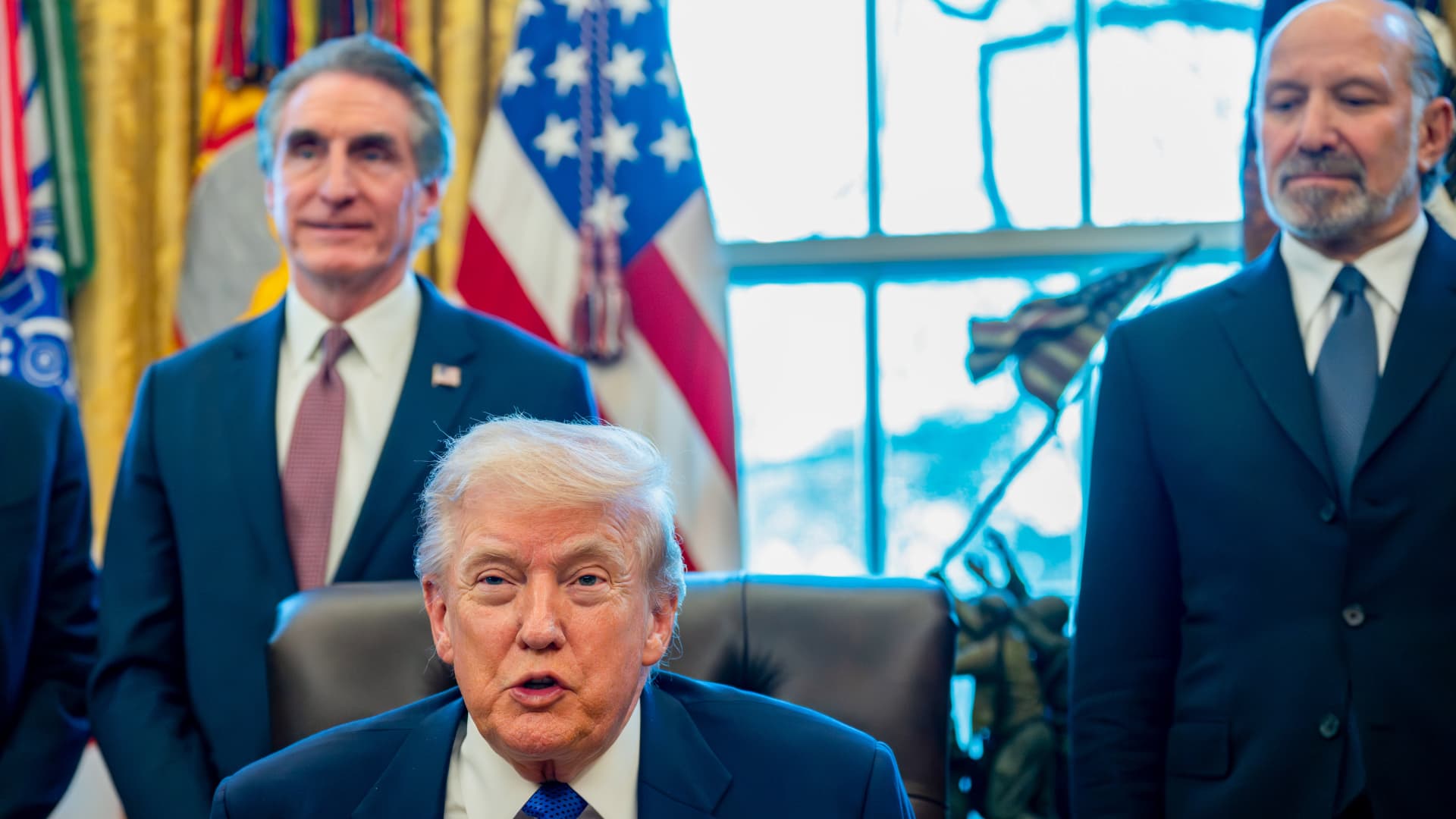
Top administration officials like Commerce Secretary Howard Lutnick and Interior Secretary Doug Burgum have argued that the U.S. government is investing in strategic industries to reduce dependence on Tawain in the case of semiconductors and China for critical minerals.
Historically, the U.S. has taken equity stakes in companies in the context of bailouts with the understanding that the investments were temporary and the government would exit its position when the company was financially viable again, said Peter Harrell, who served as the senior director for international economics under President Joe Biden.
President Barack Obama, for example, took a stake in General Motors during the 2008 financial crisis and President Franklin Roosevelt took stakes in the banking sector during the Great Depression.
But the Trump administration appears to be taking open-ended ownership interest that the U.S. government is unlikely to exit, Lincicome said. It sets a precedent that future Democratic presidents could use to invest directly in their favored industries like wind and solar, he said.
“I have yet to see a clear, coherent reason for why equity stakes are needed,” Lincicome said. Federal support that falls short of ownership stakes like loans, government contracts and other awards are widely available, he said.
After the U.S. took its stake in Intel, Lutnick told CNBC that President Donald Trump wants the American taxpayer to benefit when the government gives money to corporations.
But the administration’s approach creates political, legal and business risks for the companies involved, Harrell and Lincicome said. It also raises potential conflict of interest concerns, they said.
CNBC has reached out to the White House for comment.
Political, legal risk
The Trump administration’s approach is a major ideological departure for the Republican Party, which has traditionally championed free market capitalism and excoriated government intervention. The Democrats have typically been the party of industrial policy and intervention in markets.
Sen. Bernie Sanders and Sen. Elizabeth Warren, for example, introduced an amendment to Biden’s CHIPS Act that would have allowed the government to take stakes in companies that accept federal funding for semiconductor manufacturing. The measure ultimately died in the Senate.
Democrats have also championed the idea of a national infrastructure development bank. At least one proposal for such an entity in 2021 would have allowed the government to take equity stakes in infrastructure projects. And Biden considered launching a sovereign wealth fund.
These approaches would have relied on legislation passed by Congress. But the legal basis for the Trump administration’s investments is a grey area, Harrell said. The administration seems to rely on the rationale that it can take stakes because the law doesn’t explicitly forbid it and the companies have agreed to the deals, he said.
The lack of a clear legal basis makes the companies vulnerable to lawsuits from competitors, Harrell said. They are also likely to face political scrutiny if power changes hands in Washington, he said.
“If Democrats take control of one or both chambers of Congress in November, a bunch of the CEOs of these companies are going to be hauled up in front of committees to answer questions about how these deals are going,” he said.
Companies like MP Materials have acknowledged these risks in filings with the Securities and Exchange Commission. The Pentagon’s deal with MP includes a price floor and offtake agreement in addition to an equity stake.
MP warned investors that it could face “government audits, investigations, congressional scrutiny” and “inquiries about conflicts of interest.” It also warned the deal faces “the risk of litigation” and is vulnerable to “changes in federal administration and related executive and legislative priorities.”
Congress has also not set clear guardrails to minimize potential conflicts of interest and favoritism in the Trump administration approach, Harrell said. One concern is that the government could favor companies in which it is a shareholder in areas like permitting and contracting, he said.
USA Rare Earth was required to raise at least $500 million in private funding as a condition for its deal with the government. Commerce Secretary Lutnick’s former firm Cantor Fitzgerald led the placement for that funding. Lutnick stepped down from Cantor when he joined the Trump administration and transferred his stake in the firm to his children.
Capital misallocation risk
The equity stakes also raise the question of whether the government can be trusted to make the right bets on companies and technologies that will succeed over the long term, Harrell said.
A bad bet would result in capital flowing to less competitive companies, and investors are already speculating on which companies the government will invest in next, Lincicome said.
“That’s just straight up capital misallocation,” he said.
Business decisions could also become politicized, he said. Big companies could decide to do business with the government-backed firms to curry favor with the administration, Lincicome said.
In the case of U.S. Steel, the federal government has a governance stake, called a golden share, rather than an economic interest in the company. The White House intervened last September to stop U.S. Steel from halting production at its Granite City plant in Illinois
“That’s your worst-case scenario, that you start having politicians in Washington directing important business decisions based on political considerations and not what’s best for the long-term health of the company,” Lincicome said.
USA Rare Earth CEO Barbara Humpton told CNBC in a January interview that the government is taking “taking an economic interest” in its business “not a governance interest.” Lutnick told CNBC last August that the stake in Intel is non-voting and does not include governance rights.
“Maybe they don’t have formal voting rights,” Lincicome said of the government equity stakes. “But they do have a phone and they can pick up the phone and call. They do have the ability to influence decisions that just don’t show up on paper or in a proxy vote.”
And a Democratic president could try to force companies with government stakes to adopt progressive policies like capping executive pay or using unionized labor, Harrell and Lincicome said.
Corporate silence
Top executives have voiced virtually no public criticism of the Trump administration taking stakes. Citadel CEO Ken Griffin said this week that some executives quietly oppose the interventionist approach.
“When the U.S. government starts to engage in corporate America in a way that tastes of favoritism, I know for most CEOs that I’m friends with, they find it incredibly distasteful,” Griffin told The Wall Street Journal on Tuesday.
The number of government equity stakes is likely to grow. Lutnick told CNBC last August the Pentagon was considering stakes in major defense companies like Lockheed Martin. Trump said in January that he “will not permit” defense companies to issue dividends or stock buybacks until the firms accelerate their production of military equipment.
Before the U.S. took its stake in Intel, Trump said CEO Lip-Bu Tan was “highly conflicted” and called for his resignation over his ties to Chinese companies. The comments sparked a brief sell-off of Intel shares. Other corporate executives are likely worried about crossing the administration and being punished, Lincicome said.
“The best outcome here for your shareholders is just to stay quiet,” he said.