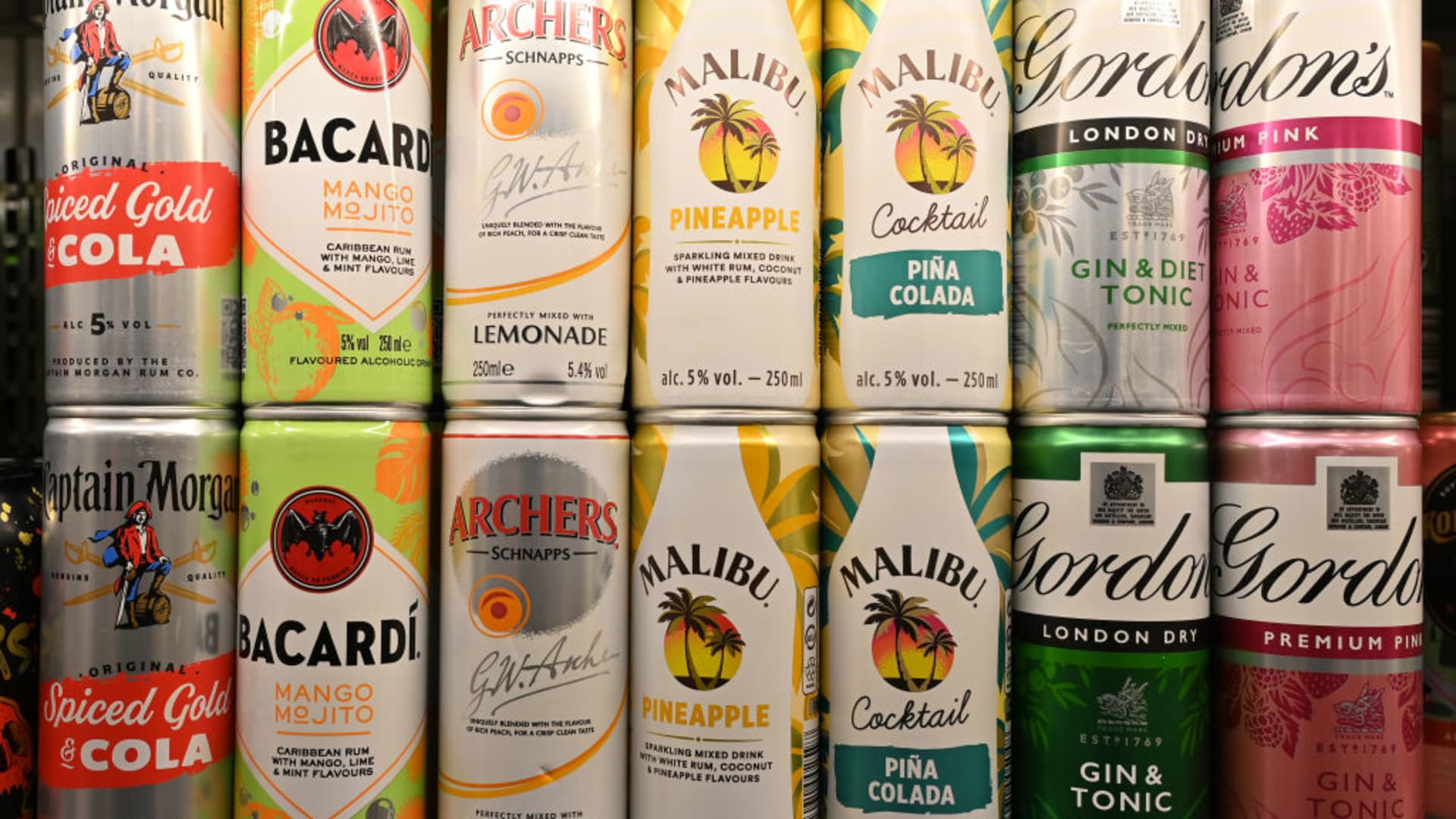
Various cans of alcoholic ready-to-drink beverages, including Captain Morgan’s rum and cola; Bacardi’s mango mojito; Archers’ schnapps and lemonade; Malibu’s pineapple and piña colada cocktails; and Gordon’s gin and tonic cocktails, are displayed for sale in a supermarket on Jan. 10, 2024.
John Keeble | Getty Images
The U.S. alcohol industry had another sobering year in 2025.
Spirits supplier revenue fell 2.2% to $36.4 billion for the year, according to new data by industry trade group the Distilled Spirits Council of the United States, or Discus. The decline came as economic pressure and weaker consumer confidence weighed on discretionary spending.
“While total U.S. spirits sales edged down 2.2% in 2025, the spirits industry remains resilient,” said Chris Swonger, DISCUS CEO and president, in a statement.
Overall volumes for the year rose 1.9% to 318.1 million 9-liter cases, indicating growing demand. But the revenue decline suggests that while Americans are still drinking, they are also trading down — opting for lower-priced spirits and pulling back on premium purchases.
Nearly every major spirits category posted revenue declines. Vodka sales fell 3% to $7 billion. Sales of tequila and mezcal — the industry’s fastest growing segment for several years now — slipped 4.1% to $6.4 billion. American whiskey and cordials revenue dipped 0.9% and 3.2%, respectively.
The exception was in convenience and value.
Last call for optimism
Sales of premixed cocktails, including spirits–based ready-to-drink beverages, surged over 16% compared to the year prior, reaching $3.8 billion. The category, known as RTD, has more than doubled its market share since 2021 as consumers gravitate toward a lower price point.
Within tequila, the shift has also been toward more affordable bottles, as macro headwinds make consumers rethink splurges on premium brands. Volume in the lowest tequila/mezcal price point the trade group tracks grew 6.5% in 2025, along with a 2.8% climb in the next tier higher. Volume for whiskey, vodka, rum and gin all fell at those price points.
As consumers move toward more affordable spirits, companies like Diageo and Brown-Forman may be best positioned, as they have the most exposure to lower-priced tequila and the fast-growing RTD category. Diageo owns Casamigos tequila and has built out a sizable portfolio of spirit-based RTDs, while Brown-Forman controls key mixed price tequila brands like El Jimador.
On the other hand, beer-heavy players like AB InBev and Molson Coors have minimal tequila exposure, although they have been expanding their RTD portfolios. Modelo and Corona owner Constellation Brands in a unique position with both beer and tequila exposure, but a smaller RTD footprint.
Overall, the beverage alcohol market has softened after years of pandemic-fueled growth, and DISCUS’ new data reinforces that normalization is now turning into contraction.
“The companies that have started to report are posting weak numbers but no worse than expected,” said Trevor Stirling, Bernstein European and American beverages analyst. “The rate of decline is not getting worse, might be slowing and one can dream of a return to volume growth.”
Lingering trade tensions
Distillers have also been navigating headwinds abroad. American spirits exports fell 9% year over year in the second quarter of 2025, amid lingering trade tensions and the removal of U.S. products from many Canadian retail shelves following President Donald Trump’s tariff hikes on the U.S. neighbor last year.
Industry leaders say tariff uncertainty is making it difficult to plan long-term.
“The unpredictability surrounding global trade issues continues to weigh heavily on the U.S. spirits sector,” said Swonger. “Reinstating zero-for-zero tariffs on distilled spirits must be a priority to get our American distillers back on a path to growth and prosperity.”
Despite the revenue pullback, spirits actually maintained its market share lead of the total beverage alcohol market at 42.4%, compared to beer and wine at 41.8% and 15.7%, respectively.
Still, the message from 2025 is clear: Consumers are drinking less, but those who are still drinking are being more selective. In a tougher economic environment, cheaper tequila and canned cocktails are winning out over premium bottles behind the bar.