President Donald Trump’s global trade war continues to have ripple effects on global trade
In the latest issue of Sea‑Intelligence, Murphy wrote there is a critical disconnect with the latest World Economic Outlook (WEO) report by the International Monetary Fund (IMF), which headlined a “steady” global economy.
“The WEO reported a global GDP growth at 3.3% for both 2025 and 2026, but an in‑depth review of the report reveals that this stability masks that world trade growth is expected to slow down significantly from 4.1% in 2025 to 2.6% in 2026,” said Murphy. “This decrease appears to be a direct consequence of the “front-loading” phenomenon seen throughout 2025, where shippers accelerated imports to pre‑empt anticipated trade policy shifts. This 2026 outlook suggests that volume growth may struggle to absorb new vessel capacity, potentially putting renewed pressure on freight rates.”
Murphy warned the IMF trade outlook is skewed because it is based on the higher-valued technology exports.
“IMF’s trade projections are based on monetary value rather than TEU (containers),” explained Murphy. “This creates a challenging scenario for container shipping stakeholders. The headline growth is largely value‑driven by the technology sector, obscuring the reality of weaker physical demand for volume‑dense goods.”
Murphy characterizes the projection, a “mirage” in terms of actual cargo volume for shipping lines. It will be less in 2026.
Ocean carriers, trucking, rail companies, and warehouses all make money by the volume of containers they move or freight stored.
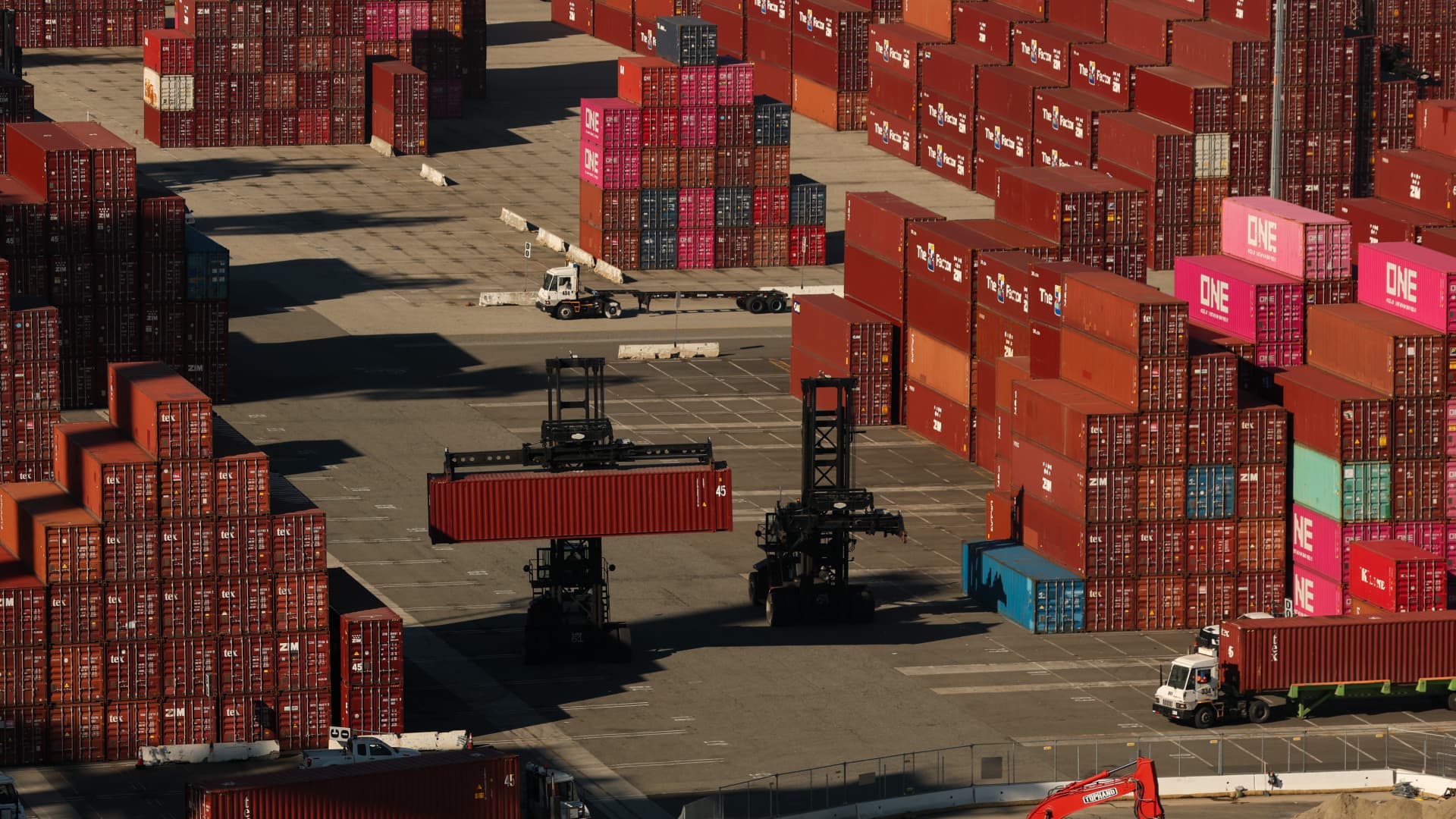
U.S. ports like Long Beach recorded record container volumes as a result of the front loading.
Helping drive that growth was trade out of Southeast Asia.
“Just a few years ago, in 2019, China, by itself, accounted for about 70% of our total volumes inbound and outbound,” said Noel Hacegaba, CEO of the Port of Long Beach. “Today, that’s down to 60%. We have seen a 10 percentage point swing of trade shifting to Southeast Asia countries like Vietnam, Thailand, Cambodia, and Malaysia.”
But with the tariff uncertainty continuing, this year, the world of trade and supply chain will be navigating what some maritime experts are calling a “double‑squeeze”.
“This is the ‘payback’ period of suppressed volumes following 2025’s front-loading, combined with the reality that trade policy shifts where the higher US tariff cost base is approximately 18.5 percent,” explained Allen Murphy, CEO of Sea-Intelligence. “In this environment, a ‘steady’ economy will not provide the booming consumer demand required to absorb these higher costs.”
These higher costs are still working their way through the supply chain, according to the January data from the Logistics Management Index (LMI).
Comparing warehousing prices in January versus December, prices were not higher but close to being the same.
Dale Rogers, a professor in the supply chain management department at Arizona State University and one of the authors of the LMI, said this reflects the bleeding down of inventories going into December.
“The fact that transportation and inventory prices are higher but warehouse prices didn’t really move indicates to me that probably we are seeing inflation that has not yet been picked up at the consumer tier of the supply chain yet,” warned Rogers.
The LMI score is a combination of eight key metrics in the logistics supply chain covering warehousing, transportation, and inventory. Any reading above 50.0 indicates that logistics is expanding; a reading below 50.0 is indicative of a shrinking logistics industry.
The January Logistics Manager’s Index reads in at 59.6, up (+5.2) from December’s reading of 54.2. This is the fastest level of expansion since May of last year.
Compared to January 2025, it is down (-2.4) from a reading of 62.0.
“The overall rate of expansion is largely due to a shift back towards milder restocking to start the year,” said Rogers. “This suggests that respondents kept with their future predictions from last year and running inventories relatively lean to start the year. This is possibly reflective of the continued high costs.”
Inventory Costs in January were up (+8.4) at 71.3, pushing them back above the significant expansion threshold of 70.0.
“The expansion in inventory is reflected in Warehousing Capacity dropping (-11.2) to 50.0 and no movement,” said Rogers. “Warehousing Utilization is the mirror image, bouncing back (+11.6) from contraction to expansion at 54.4.”
Diving into transportation capacity, the LMI is recording it has slowed(+10.9) from 36.9 to a milder rate of 47.1. As a result, transportation prices have increased (+4.8) at 71.4. This supply chain segment is expanding more quickly than at any time since April of 2022.
Rogers tells CNBC the headline of the report to him is that transportation prices and inventory costs are substantially higher, while the other cost – Warehousing, is not.
“This poses an interesting question: are the higher transportation prices and inventory costs happening because the economy is getting better, or is it inflation due to the tariffs?” said Rogers. “Sometimes inflation signifies an improving economy, but these increases have to be at least partially about the tariffs.”‘
This is not the first time Rogers has warned inflation is brewing in the warehouse.
On Capitol Hill, Treasury Secretary Scott Bessent said the tariffs were not inflationary.
Too Many Vessels
With no surge of freight on the horizon and more ocean carriers starting to return to the Red Sea, fewer vessels will be needed. The Red Sea is a faster trade route from Asia to Europe, so the vessels that were once added to the longer trade route around the Horn of Africa will no longer be needed.
This overcapacity was referenced as one of the reasons behind A.P. Moller – Maersk’s announcement of 1,000 job cuts. The integrated logistics provider cited the vessel overcapacity has pushed average freight rates lower by 23 percent across all shipping routes in the fourth quarter. This rate decline led to a $153 million earnings loss at the company’s main shipping business.
